


70V vs. Low Impedance: How to Spec a Commercial Ceiling Speaker Zone
If you've spent any time speccing a distributed audio zone, you've run into the same fork in the road every time: 70V (or 100V) line, or low impedance? Full-depth ceiling speaker, or low-profile? One amplifier per zone type, or one that does both? Get any of those wrong and you either under-power the room, blow a budget on gear you didn't need, or find out mid-install that the ceiling speaker you ordered doesn't fit above the drop tile. This guide walks through the decision in the order you'll actually make it on a real job. It's one piece of a broader commercial AV system design, so it's worth coordinating speaker and amplifier choices with the rest of the install rather than speccing the zone in isolation.
Want a distributed audio zone speced for your space?
SoundPro's Certified Account Managers spec commercial background and foreground audio systems every week.
Talk to a Specialist →70V/100V vs. Low Impedance: What Actually Changes
Both are ways of getting an amplifier's power to a speaker. Low impedance (sometimes called Lo-Z or 8-ohm) is the same wiring scheme as a home stereo: the amp drives the speaker's coil directly, at whatever impedance the speaker presents (commonly 4, 8, or 16 ohms). 70V/100V (Hi-Z, or constant-voltage) puts a step-up transformer in the speaker itself, letting the amp push a constant, higher voltage down the line to many speakers at once, each tapped to draw only the wattage it needs.
| Factor | Low Impedance (Lo-Z) | 70V/100V (Hi-Z) |
|---|---|---|
| Best for | Fewer speakers, higher fidelity, foreground music | Many speakers, long cable runs, background/paging |
| Wiring | Careful impedance matching required per zone | Add speakers freely up to the amp's wattage tap budget |
| Cable runs | Signal loss increases with distance | Minimal loss over long runs due to higher voltage, lower current |
| Typical spaces | Small restaurants, boutique retail, listening rooms | Large retail floors, hotels, warehouses, multi-room houses of worship |
You often don't have to pick just one. Amplifiers like the Sonance PowerZone Connect series run in either mode per channel, with automatic power-sharing that proportionally distributes output whichever way you wire it, so one amp can drive a Lo-Z zone on channel 1 and a 70V zone on channel 2 without swapping hardware.
The practical question that usually settles the decision is: how many speakers, and how far apart? A small dining room with six speakers and a 40-foot longest run works fine in low impedance, and you'll get a slightly more detailed, higher-fidelity result out of it. A big-box retail floor with thirty speakers spread across 15,000 square feet needs 70V, running that many speakers in Lo-Z would mean either an unreasonable number of amplifier channels or an impedance mismatch that damages the amp. There's no wrong answer as long as the topology matches the room; the mistake is picking Lo-Z out of habit for a zone that's really a 70V job, or over-speccing 70V taps on a small, acoustically simple space where low impedance would sound better for the same money.
Choosing the Ceiling Speaker: Check Your Plenum Depth First
Before comparing frequency response or SPL, check the one spec that actually determines whether a speaker fits: mounting depth. HVAC ducting, structural beams, and low floor-to-floor heights routinely leave less than 5 inches of usable plenum space above a drop ceiling. A standard in-ceiling speaker won't clear that; a low-profile model will.
| Spec | PS-C63RTLP | PS-C83RT |
|---|---|---|
| Woofer size | 6.5" | 8" |
| Mounting depth | 4.37" (111 mm) — fits below HVAC ducting | 9.84" (250 mm) — standard plenum depth |
| Power handling | 120W program / 60W pink noise | 160W program / 80W pink noise |
| Frequency response (-3dB) | 65Hz–20kHz | 55Hz–20kHz |
| Best use case | Restricted-depth ceilings, retrofit jobs | Open plenum, higher SPL or deeper bass needs |
Both share the same tweeter design, a pivoting chambered 1" soft dome that angles to maintain coverage even when ceiling geometry forces an off-center speaker placement, and both use a one-piece magnetic bezel-less grille that paints in one step to disappear into a finished ceiling. If plenum depth isn't a constraint, the PS-C83RT gives you more headroom and deeper bass extension for the same footprint. If it is, the PS-C63RTLP is the one that actually goes in.
The same Pro Series lineup covers other footprints, too: the PS-C43RTLP is a 4-inch low-profile speaker for even tighter plenum spaces or in-wall use in 2x4 stud bays, and the PS-C61RT is a standard-depth 6-inch option that sits between the 63RTLP and 83RT on power handling and cost.
Don't forget the finishing hardware
Both speakers ship with a C-Bracket and Tile Bridge for support during install, along with a sealed metal enclosure, removable Euroblock connector with loop-through, and seismic attachment for code compliance. The magnetic bezel-less grille takes a single coat of paint to match the ceiling and disappear visually, but if the space uses square downlights or square HVAC diffusers, order the optional Square Grille Adapter separately so the round speaker grille reads as part of a consistent square pattern rather than an odd shape breaking up the ceiling's sightlines. It's a small line item that's easy to forget until the ceiling is finished and the mismatch is obvious.
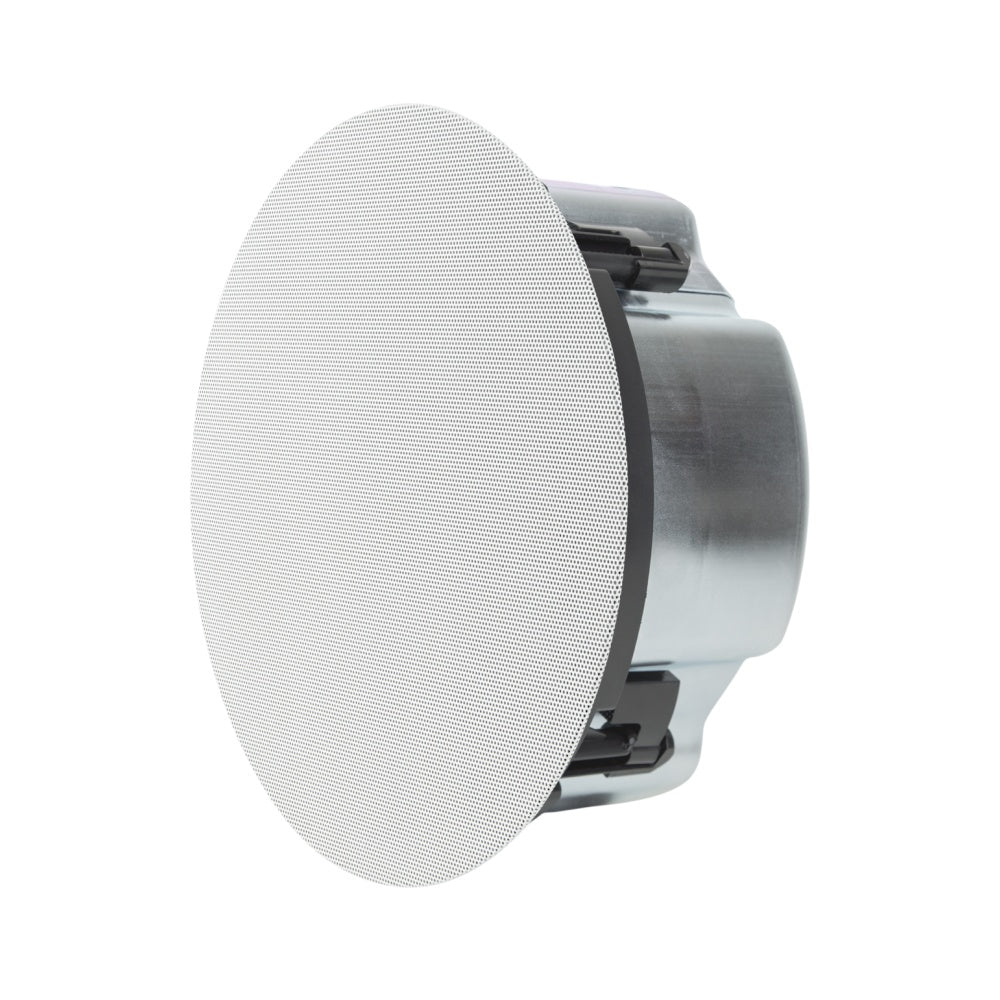
Featured Gear — Low-Profile In-Ceiling Speaker
PS-C63RTLP Low-Profile Speaker (Sonance)
A 6.5-inch two-way in-ceiling speaker with only a 4.37" mounting depth, built for restricted plenum spaces like ceilings with HVAC ducting. Same magnetic bezel-less grille and pivoting tweeter design as the PS-C83RT, in a shallower footprint.
Shop at SoundPro →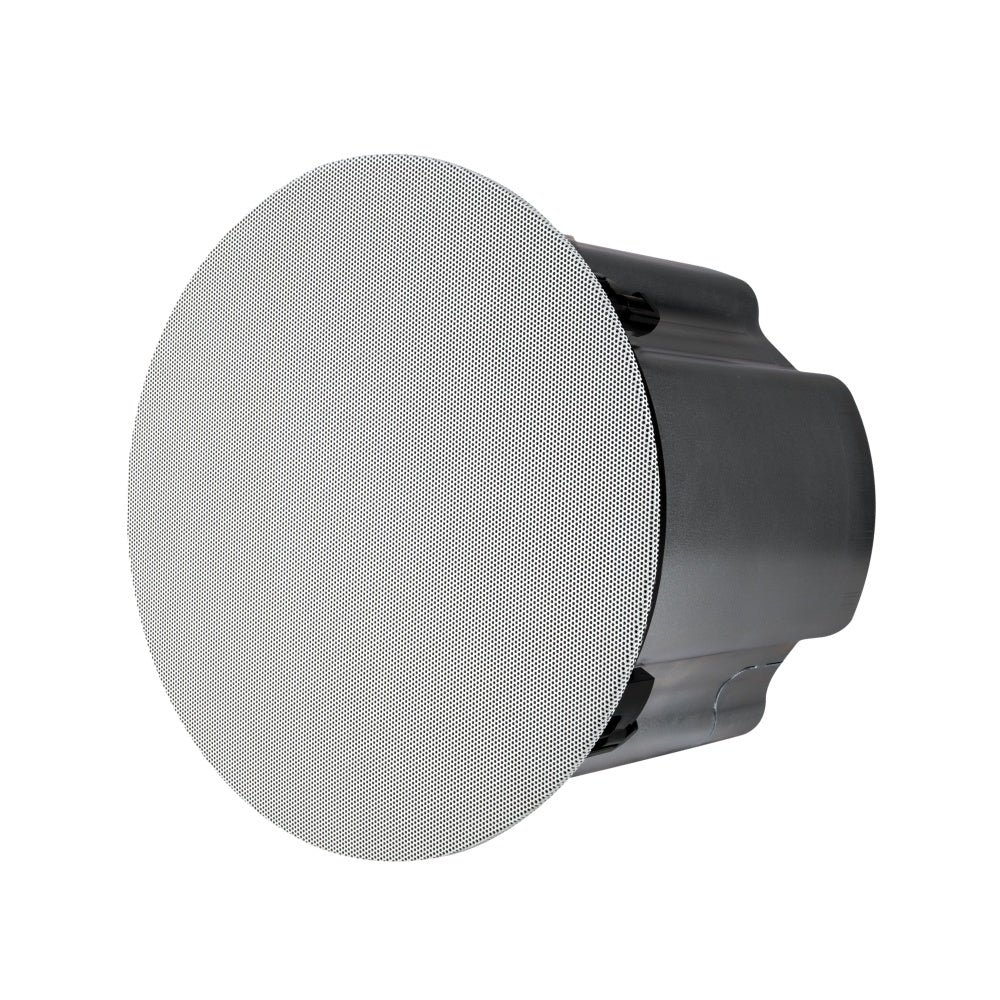
Featured Gear — In-Ceiling Speaker
PS-C83RT Ceiling Speaker (Sonance)
An 8-inch two-way in-ceiling speaker for commercial installs that need broad low-frequency extension and high SPL. Sealed metal enclosure, magnetic bezel-less grille, UL 1480 and UL 2043 certified, C-Bracket and Tile Bridge included.
Shop at SoundPro →Sizing and Setting Up the Amplifier
The Sonance PowerZone Connect 252 is a 2-channel, 250W-per-channel DSP amplifier that drives low-impedance loads from 4 to 16 ohms and constant-voltage 70V/100V lines from the same chassis, with automatic power-sharing across channels in either mode. It fits a slim 1U half-rack space, which matters in equipment closets where a 2U amp simply doesn't have room.
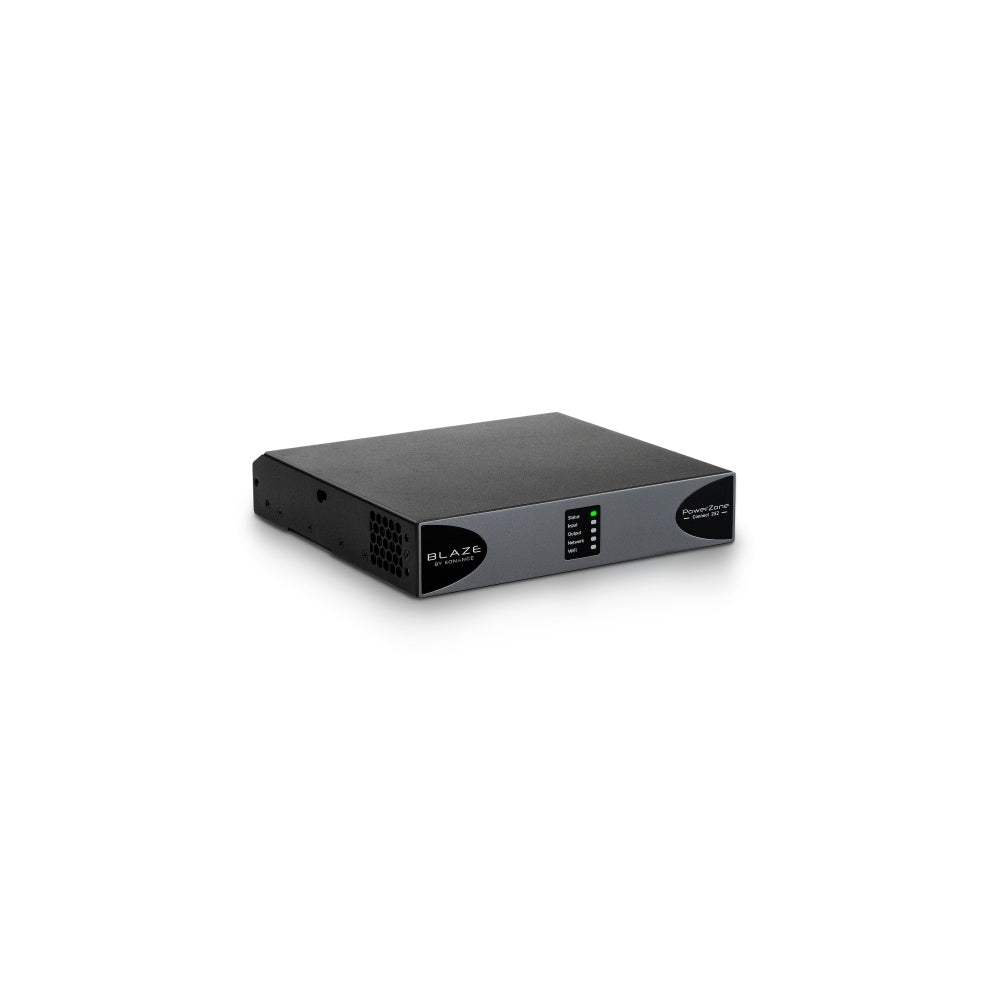
Featured Gear — DSP Amplifier
PowerZone Connect 252 (Sonance)
A 2-channel, 250W-per-channel DSP amplifier that drives Lo-Z or 70V/100V loads from a slim 1U chassis, with the PowerZone Control zone app built in, no external DSP required.
Shop at SoundPro →Everything else lives in the browser-based PowerZone Control web app, built directly into the amplifier:
- Multi-zone routing and input mixing — assign sources to zones without external switching hardware
- Priority and ducking — page over background music automatically
- Parametric EQ and high-pass filters — tune each zone to the room and the speaker
- Speaker presets and delay — match settings to the Sonance ceiling speakers you've installed
- Wall-mounted controller setup — hand end users a simple volume/source control without touching the DSP
There's no separate DSP box to buy, network, or troubleshoot, the zone processing is already inside the amplifier.
Sizing the wattage taps
For a 70V/100V zone, add up the wattage tap you plan to set on every speaker in that zone, then build in roughly 20% headroom above that total before choosing your amplifier channel's power rating. A zone of six PS-C63RTLP speakers tapped at 15W each is a 90W load, comfortably inside a single 250W channel on the PowerZone Connect 252, with room to add more speakers to the same line later.
Worked example: a retail floor calls for twelve ceiling speakers split into two zones of six. Each speaker is tapped at 15W for background music, giving each zone a 90W load. Adding 20% headroom brings the design target to about 108W per zone, well within a single 250W channel, so both zones fit on one PowerZone Connect 252 with capacity to spare if the client later asks for louder foreground music during promotions. If the same floor instead needed four independent zones, the 4-channel PowerZone Connect 254 covers that from a single 1U chassis without adding a second rack unit.
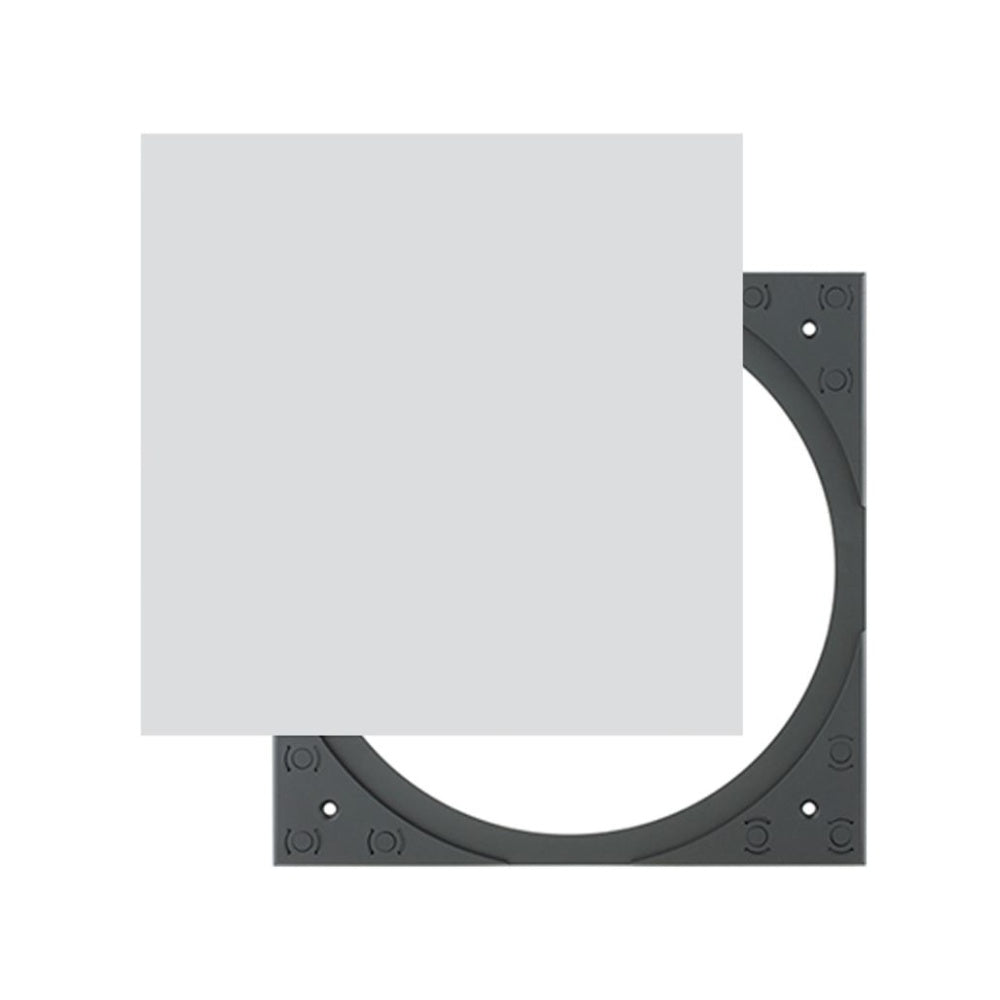
Featured Gear — Finishing Accessory
Square Grille Adapter (Sonance)
Converts the round ceiling cutout on a PS-C83RT or PS-C63RTLP into a clean square aperture, so the speaker matches square downlights, HVAC return grilles, or ceiling-tile-aligned diffusers. One-step paintable, removable Sonance logo badge.
Shop at SoundPro →Scaling past two channels
The 252 covers two zones. For a larger buildout that needs four independent zones from one chassis, the PowerZone Connect 254 is the 4-channel version of the same amplifier platform, configured the same way through the same PowerZone Control web app. For jobs that need more than four zones, multiple PowerZone Connect units can be run side by side in the same rack, each handling its own set of zones.
Not sure which amplifier or how many zones you need?
Send us your floor plan and speaker count and our Commercial Sound team will map the right amp, channels, and controllers to your space.
Get a Custom Quote →Who This Setup Is For
This combination, plenum-appropriate ceiling speakers plus a DSP amplifier that handles either wiring scheme, covers most of the spaces that need background or foreground commercial audio:
- Restaurants and retail — background music during service hours, switched to paging or promotional announcements without a separate PA system
- Hospitality — lobbies, corridors, and meeting spaces each running as independent zones off one rack, with front-desk staff controlling volume from a wall-mounted controller
- Fitness studios — higher-SPL foreground music in workout areas alongside a quieter background zone in the lobby, split across two channels of the same amplifier
- Houses of worship — sanctuary, fellowship hall, and overflow rooms on separate zones, with the ability to duck music under a paging or livestream feed automatically
If you're speccing paging or announcement-only coverage at very low wattage, a simpler amplifier may be enough; once you need zones, priority ducking, or a mix of speaker types on one system, the DSP amplifier earns its place in the rack. For a deeper technical breakdown of how constant-voltage distribution works at the wire level, AVIXA-affiliated audio expert Chuck Espinoza walks through the physics in an interview with CIE Group's How To AV series.
Installation Checklist
Use this as your punch list before ordering gear or opening the ceiling.
- Confirm plenum depth at every speaker location before ordering, not after the ceiling is open.
- Decide Lo-Z or 70V/100V per zone based on speaker count and cable run length, not habit.
- Add up wattage taps per zone and build in 20% headroom before selecting the amplifier channel rating.
- Plan for priority/ducking sources (paging mic, fire panel override) during initial zone setup, not as an afterthought.
- Decide on end-user control — a physical wall-mounted controller, or management entirely through the PowerZone Control web app.
- Order finishing hardware — Square Grille Adapters, rough-in brackets — alongside the speakers, not as a follow-up order.
Ready to spec the zone?
Talk to a SoundPro Commercial Sound specialist · 972-550-0001 · info@soundpro.com · Hablamos español
Talk to a Specialist →Frequently Asked Questions
Can I mix 70V speakers and low-impedance speakers on the same amplifier?
How do I know if I need a low-profile ceiling speaker?
What's the difference between 70V and 100V?
Do I need a separate DSP processor with a PowerZone Connect amplifier?
How many speakers can one amplifier channel support?
Can end users control volume without accessing the DSP software?
This article is provided for general educational purposes. Actual amplifier sizing, wattage tap settings, and code requirements (including seismic and plenum-rating rules) vary by jurisdiction and installation. Consult your local code and a licensed installer for final system design.