


Waves Dugan Automixer & Dugan Speech Plugin Bundle
Waves Dugan Automixer & Dugan Speech Plugin Bundle
SoundPro Item: 73214 | Part Number: DDBNDL
Usually ships in 5-7 business days
- Official Dugan plugins developed in association with Dan Dugan
- Includes Dugan Speech for the eMotion LV1 console and SuperRack for other mixing consoles + Dugan Automixer (for other mixing consoles via MultiRack only)
- Auto-mix up to 64 live microphones in real time
- No need to ride faders manually
- Ideal for scenarios involving several participants and microphones
- Automatically reduces noise and feedback
- Ensures consistent overall gain
- Perfectly matched transparent crossfades
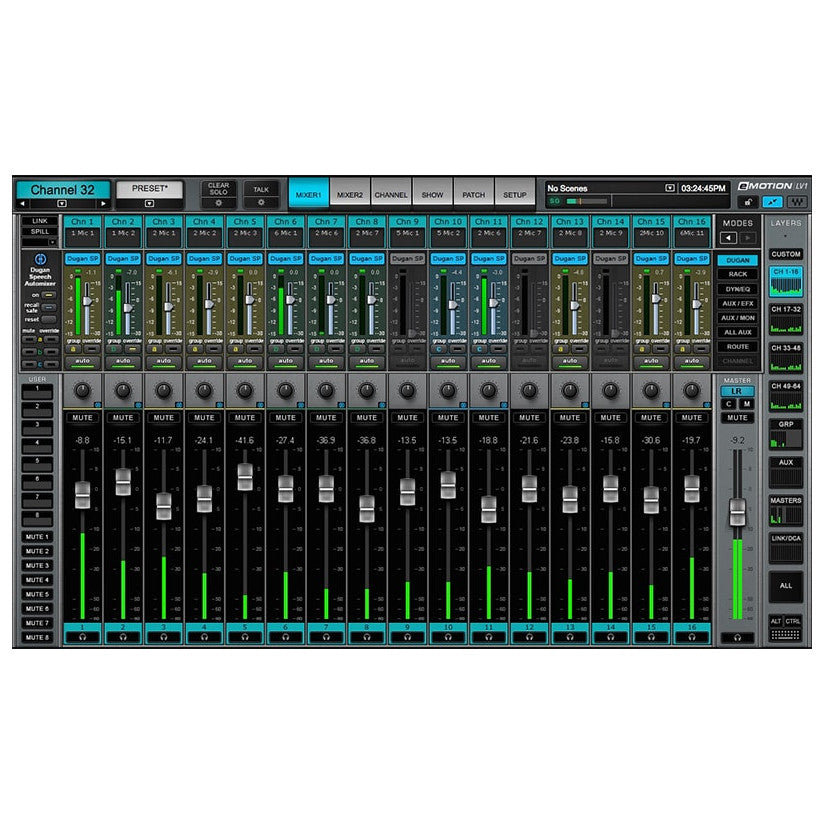
In this high-value package, you get the Dugan Speech plugin for integrated use inside the eMotion LV1 mixing console, and the Dugan Automixer plugin for use with other major consoles via the SuperRack plugin host. Developed with pro audio inventor Dan Dugan, both Dugan plugins are powered by his patented voice-activated process.
Mixing multiple microphones can be easy: 2 plugins for auto-mixing several mics in real time, one for the eMotion LV1 mixer, one for other live consoles (via SuperRack).
Dugan Speech and Dugan Automixer are the definitive solution for broadcast news panels, radio and TV talk shows, houses of prayer, motion picture dialog recording, discussion panels, and any other situation involving numerous microphones and participants.
The Dugan plugins save you the need to manually ride faders while trying to keep up with several people talking. They can auto-mix up to 64 channels simultaneously and make perfectly matched crossfades, without compression or noise gates that would cause unwanted artifacts. They also reduce noise, feedback and comb filtering from neighboring microphones, ensuring consistent overall gain even when numerous speakers are talking simultaneously.

Specifications
FAQs
Q: What is the difference between the Waves Dugan Automixer and the Dugan Speech plugin?
A: Both plugins use Dan Dugan's patented automatic mixing algorithm, but they are designed for different host environments. The Dugan Speech plugin is built for native use inside the Waves eMotion LV1 mixing console and the SuperRack plugin host, giving you deep integration and a dedicated channel strip interface within those platforms. The Dugan Automixer is designed for use with other major live consoles via the Waves MultiRack host, including DiGiCo SD consoles. This bundle gives you both, so you're covered regardless of which console platform your venue or production relies on.
Q: How many microphones can the Waves Dugan plugin handle simultaneously?
A: The Dugan Automixer plugin supports up to 64 inputs and outputs simultaneously, making it one of the most scalable automatic mixing solutions available for live production. The Dugan Speech plugin operates in mono or stereo channel configurations within its supported hosts. Both plugins deliver zero latency processing at 44.1 kHz and 48 kHz sample rates, which is critical for live environments like church services, conference panels, broadcast news desks, and town halls where any audible delay would be unacceptable.
Q: Is the Waves Dugan Bundle a good fit for houses of worship?
A: Yes, the Dugan bundle is widely regarded as one of the best automatic mixing solutions for houses of worship. In a typical church setting, you may have a pastor, worship team members, and panel speakers all on open microphones simultaneously. Without automatic mixing, engineers must manually ride faders to prevent feedback, noise buildup, and comb filtering. The Dugan algorithm constantly monitors all open mics and redistributes gain automatically, keeping the overall system gain constant regardless of how many people are speaking. This makes services significantly easier to manage and dramatically improves audio clarity for both in-room audiences and livestream viewers.
Q: Does the Waves Dugan Bundle use noise gates or compression to control open microphones?
A: No, and this is one of the key technical advantages of the Dugan algorithm over traditional automixer approaches. Rather than using noise gates (which cause abrupt, unnatural cutoffs) or compression (which can color the sound), the Dugan process uses a gain-sharing algorithm that smoothly redistributes gain across all active channels in real time. The result is perfectly matched, transparent crossfades that are inaudible to the audience. This is why the Dugan method is the industry standard for broadcast news panels, conference rooms, and houses of worship where natural-sounding, artifact-free audio is non-negotiable.
Why Choose SoundPro?
Since 1972, SoundPro has been the trusted source for audio, video, and lighting gear. Whether you're starting your AVL journey or are a seasoned professional, we're here to help you every step of the way.
-

Certified Account Managers
Our Account Managers, with 16+ industry certifications, are ready to find your solution.
-

Personalized Pricing
We know every project is unique. Get a personalized quote anytime you need it
-

Fast Shipping & Local Pickup
In stock items ship same day if ordered by 4pm CST. Pickup offered in Irving, TX.
-

Accountability from Real People
We aim for a smooth, transparent experience by setting and sticking to clear expectations.
-

Easy Payments & Financing
We accept all major credit cards and also offer financing through our partners.


