


Best IEM Setup for Drummers: How to Get a Great Monitor Mix on Stage
Finding the best IEM setup for drummers is harder than it looks. You're surrounded by your own acoustic instrument, isolated in a shell or behind a screen, further from the FOH engineer than anyone else, and you need to hear click, kick, bass, and vocals all competing in a mix that has to cut through 105dB of live drums. If you've been fighting your monitor mix for years, this guide is for you. Here's exactly what you need in a drummer IEM setup, what to look for in each component, and the two wireless systems SoundPro's specialists recommend most. If you're newer to IEM systems generally, our Complete In-Ear Monitor Guide for 2026 covers the full signal chain from console aux send to earphone fit before you dive into the drummer-specific content here.
Talk to a SoundPro specialist with 16+ industry certifications for real answers, fast.
- Why Drummers Need a Different IEM Setup Than Everyone Else on Stage
- What a Drummer Actually Needs in Their IEM Mix
- Wireless vs. Wired IEMs for Drummers
- Best Wireless IEM Systems for Drummers in 2026
- Choosing Earphones: Why Driver Type Matters for Drummers
- How to Build a Great Drummer Monitor Mix
- Quick Comparison: PSM 300 vs Sennheiser EW IEM G4
- Next Steps
- FAQ
Why Drummers Need a Different IEM Setup Than Everyone Else on Stage
Every performer on stage has a monitor challenge. But drummers have a category all their own. Three things make the drummer's monitoring situation uniquely difficult.
First, the acoustic bleed. Even with a drum shield or full enclosure, a live kit is producing 95 to 110dB of direct acoustic sound directly into the drummer's ears before any IEM signal reaches them. That means the IEM system has to work against significant competition, not just fill a quiet space. You need passive isolation that actually blocks that acoustic bleed, or you end up turning your IEM volume up to dangerous levels just to hear the mix over your own kit.
Second, the click track. Most drummers are the only person on stage required to track to a click, and the click has to be audible at all times. In a wedge system, the click ends up getting buried in stage wash or turning into a fatiguing repetitive pulse at volume. In a properly configured IEM system, the click sits clearly in the mix without the volume war. But getting there requires a monitor mix built for a drummer, not adapted from the band's generic mix.
Third, the low-frequency problem. Kick drum and bass guitar are the foundation of every drummer's mix, and they also happen to be the frequencies that are hardest to reproduce accurately in an IEM earphone. An earphone that can't handle the low end will leave a drummer feeling disconnected from the rhythm section, playing harder than necessary to compensate, and fatiguing faster through a long set.
"The number-one complaint SoundPro hears from drummers who switch to IEMs is that their monitor mix didn't translate. It sounds nothing like the room they were used to. That's fixable with the right mix approach, and it starts with understanding what a drummer actually needs to hear versus what everyone else on stage needs."
What a Drummer Actually Needs in Their IEM Mix
This sounds obvious, but it's worth stating directly: a drummer's monitor mix should be built from scratch for a drummer, not pulled from the main mix or adapted from a vocalist's IEM feed. Here's what to prioritize.
- Click track, front and center. The click needs to be unambiguous, consistently audible, and not fighting anything else in the mix. Many drummers prefer the click slightly panned to one side so it feels separate from the music rather than part of it. A cowbell or rimshot click sound often cuts through better than a basic metronome beep in a loud environment.
- Kick drum prominence. The acoustic kick is already loud, but an IEM mix without a clear kick signal leaves drummers feeling disconnected. Pull the kick up higher than you think you need it. The isolation from the IEM earphone will shift your perception; you need that anchor in your ears, not just through your feet.
- Bass guitar. Kick and bass lock together. Drummers who can't hear the bass player will unconsciously rush or drag. Get a clear bass signal in the mix, even if the bass amp is behind you and you can feel it acoustically.
- Guide vocal. Most drummers don't need every vocal in their mix, but they do need the lead vocal or worship leader to track dynamics and phrasing. One clear lead vocal is usually enough.
- Ambient mic blend. This is the most overlooked element in a drummer's IEM mix. A small omnidirectional microphone placed at the front of the kit, blended into the monitor at a low level, restores the natural sense of room connection that full isolation removes. Without it, playing IEM-isolated in a live room can feel unnatural and disorienting. With a subtle ambient blend, the mix locks in immediately.
Wireless vs. Wired IEMs for Drummers
For every other performer on stage, the choice between wireless and wired IEMs is mostly about freedom of movement. For drummers, there's a legitimate case for wired IEMs that doesn't apply elsewhere: you're not moving. A drummer is planted at the kit for the duration of every song. A cable run from a headphone amp or bodypack to your earphones isn't a practical limitation the way it is for a worship leader walking the stage.
That said, wireless is still the right choice for most drummers, for one reason: cable management on a drum kit is genuinely difficult. A cable that runs from a rack unit to your ears has to survive the physical environment of playing drums, and cable noise transmitted through movement is a real issue with IEM cables. A wireless system eliminates that entirely. The bodypack clips to the back of your shirt or to the kit itself, and there's no cable path long enough to introduce noise.
Wired IEM setups do make sense for studio sessions, rehearsal rooms, or budget-first scenarios where a quality headphone amp feeding your earphones directly from the console aux is a clean and inexpensive solution. For consistent live performance, wireless is the cleaner choice.
Best Wireless IEM Systems for Drummers in 2026
There are two professional wireless IEM platforms SoundPro's specialists recommend most for drummers. Both are tried and proven in demanding live environments. Here's what to know about each.

The PSM 300 is the benchmark for drummer wireless IEM setups because of one specific feature: MixMode. MixMode lets the drummer blend two console inputs directly from the bodypack, which means you can keep the click on one channel and your mix on the other, adjusting the balance between them at the kit without involving the monitor engineer. Shure's patented Audio Reference Companding delivers one of the cleanest wireless audio chains at this price, which matters for preserving the transient accuracy that drummers need to hear in kick and snare. The one-touch frequency scan and sync keeps setup fast even for volunteer-run tech booths.
Shop at SoundPro →
The EW IEM G4 is the stronger choice for drummers in dense RF environments or venues with heavy wireless traffic from other systems. Up to 1,680 tunable UHF frequencies give your system room to find clean channels even when the stage is loaded with mics, guitar links, and other IEM systems. The G4's HDX companding delivers transparent, natural audio, and up to 330 feet of range means RF performance is never a concern from the back of the kit to the transmitter rack. The included IE 4 earphones get you playing immediately; the system pairs with any professional IEM earphone for an upgrade path.
Shop at SoundPro →Choosing Earphones: Why Driver Type Matters for Drummers
Most IEM earphones are optimized for vocal clarity and midrange detail. That's fine for singers and acoustic guitarists. Drummers need something different. The two things that matter most are passive isolation and low-frequency accuracy.
On isolation: you're playing in the loudest acoustic environment on stage. The earphone's passive isolation spec, measured in dB of noise reduction, directly determines how much of your own kit bleeds through into your monitoring experience. Less bleed means you can hear your mix at safer, lower volumes. Look for earphones rated at 26dB of passive isolation or better. The Shure SE215 Pro, at 37dB of passive isolation, is the standard professional starting point.
On low-frequency accuracy: dynamic driver earphones generally handle bass and kick better than single balanced-armature designs because dynamic drivers move more air and reproduce the physical impact of low frequencies more naturally. Multi-driver IEMs that combine a dynamic driver for lows with balanced armatures for mids and highs are the ideal for drummers who want full-range accuracy without sacrificing midrange clarity for the click and vocal. The Shure SE215 Pro is a single dynamic driver, which makes it a natural choice for drummers who prioritize kick and bass feel in their mix.
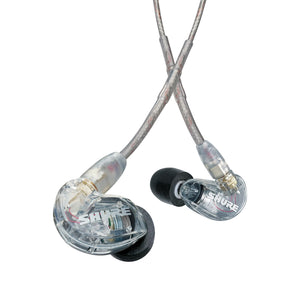
The SE215 Pro is the standard professional IEM earphone for drummers and the most common earphone upgrade from whatever comes in the box with a wireless system. Single dynamic driver with 37dB of passive noise isolation, detachable MMCX cable so a damaged cable is a quick inexpensive fix, and an over-ear fit that stays in place through the most physical drumming. Compatible with Shure PSM bodypack adapters for a direct cable connection. Available at SoundPro's IEMs and earphones collection.
Shop Earphones at SoundPro →SoundPro's specialists configure IEM systems for drummers and live production teams every week.
How to Build a Great Drummer Monitor Mix
The system is only half the equation. A great wireless IEM setup with a bad monitor mix still sounds bad. Here's the approach SoundPro's specialists walk through with drummers who are new to IEM monitoring.
Start with the click, set everything else around it
Before you touch any other channel, get your click level right. You want it audible at your lowest comfortable listening volume. Everything else in the mix lives in relation to that baseline. If you set the click last, you'll end up fighting everything else in the mix to find it.
Use a dedicated click bus, separate from your drummer IEM mix
If your console supports it, route the click to a separate aux send from the rest of your monitor mix and feed both into the transmitter's two inputs using MixMode on the PSM 300, or a stereo split on the EW IEM G4. This gives you independent volume control over click vs. music from the bodypack itself, without asking the monitor engineer to adjust anything mid-song.
Build in stereo from the start
Mono IEM mixes are unnecessarily fatiguing. A stereo mix panned correctly gives each element its own space: kick and bass centered, guitars panned wide, click on a slight off-center position where it's always audible but not competing with everything else. Running stereo is a no-cost upgrade that immediately reduces listening fatigue over a long set or service.
Add an ambient mic to your drum monitor mix
A small omnidirectional microphone on a stand at the front of the kit, blended subtly into your monitor mix, restores the ambient connection to the room that full IEM isolation removes. You can hear the congregation, the room response, and the natural energy of the performance without removing the isolation you need to keep your volume at a safe level. This is the single addition most drummers say changes the IEM experience from clinical to comfortable.
Keep the mix lean
Drummers don't need every channel in their mix. Click, kick, bass, lead vocal, and ambient room is often all you need. Resist the temptation to add everything and then try to balance it. Start with five elements and add only what's genuinely missing. A simpler mix is easier to live with through a full service or set.
Quick Comparison: PSM 300 vs Sennheiser EW IEM G4 for Drummers
| Feature | Shure PSM 300 | Sennheiser EW IEM G4 |
|---|---|---|
| Audio quality | Patented Audio Reference Companding, extremely clean | HDX companding, transparent and natural |
| Click track advantage | MixMode: blend click and mix from bodypack | Single mix, volume adjust from bodypack |
| RF frequency options | Band-dependent; fewer frequencies per band | Up to 1,680 tunable UHF frequencies |
| Range | Up to 300 ft line of sight | Up to 330 ft line of sight |
| Best for | Click-track management, cleaner audio chain | Dense RF environments, large stage setups |
Next Steps
If you're ready to move from wedges to in-ears, or you're replacing a wireless system that isn't performing for you, here's how to get from this article to a system that works.
- Identify what you already have. Check your console's aux/mix bus count. If you're on a digital console with dedicated aux sends, you may already have the routing infrastructure for a wireless IEM system. You might just need the transmitter, bodypack, and earphones.
- Assess your RF environment. How many other wireless systems are active on your stage? If you're running multiple mics, guitar links, and IEM systems for other performers, you need a clear picture of what frequencies are available before you pick a band. SoundPro's Account Managers can help you coordinate this.
- Budget for the whole system. A complete single-channel drummer IEM setup runs $800 to $1,500 at the professional tier with quality earphones included. Build in cost for cabling, an ambient mic if you want one, and any accessories for your bodypack mount at the kit.
- Read our complete IEM guide. Our Complete In-Ear Monitor Guide for 2026 covers every component in an IEM system in detail, including how to configure your console's aux sends, how to coordinate RF, and budget recommendations for every system size.
- Talk to SoundPro. Our specialists configure IEM systems for drummers in churches, touring rigs, and venue installs every week. A 15-minute conversation can save you from a $1,500 mistake and make sure every component in your setup works together from the first soundcheck.
- Wireless IEM Systems at SoundPro
- IEM Earphones at SoundPro
- The Complete In-Ear Monitor Guide for 2026
- Best Digital Mixer for Church in 2026
Get a custom quote from SoundPro's certified specialists. We'll match the right system to your stage, console, and RF environment.
FAQ: IEM Setup for Drummers
What is the best IEM system for drummers?
The Shure PSM 300 is the top recommendation for most drummers because of its MixMode feature, which lets you independently blend the click track and your monitor mix directly from the bodypack without involving the monitor engineer. The Sennheiser EW IEM G4 is the stronger choice for drummers in venues with dense RF environments or stages with heavy wireless traffic. Both are professional-grade systems that perform reliably in demanding live settings.
Do drummers need wireless IEMs, or is wired fine?
Either works, but wireless is the better choice for most live performance environments. While drummers don't move around the stage the way vocalists do, cable management on a kit is genuinely awkward, and cable noise transmitted through physical movement is a real issue with long IEM cable runs. A wireless bodypack clipped to the back of your shirt or attached to the kit eliminates both problems. Wired IEM setups fed from a headphone amplifier are a fine choice for rehearsal rooms, studio sessions, or budget-first installs where mobility isn't a factor.
What should a drummer hear in their IEM mix?
A drummer's monitor mix should be built specifically for their role, not adapted from a general band mix. The core elements are click track (highest priority), kick drum, bass guitar, and lead vocal. An ambient microphone blended subtly into the mix restores the natural room connection that full IEM isolation removes. Keep the mix lean: five well-placed elements beats ten competing ones. Start with the click at a comfortable level and build everything else in relation to that baseline.
What earphones are best for drummers?
Drummers need earphones with high passive isolation (26dB or better) to block out acoustic bleed from the kit, and good low-frequency accuracy to hear kick and bass clearly in the mix. The Shure SE215 Pro is the standard professional starting point: 37dB of passive isolation, single dynamic driver that handles low frequencies naturally, and a detachable MMCX cable so a damaged cable is an inexpensive fix rather than a full replacement. For drummers who spend many hours in IEMs, a multi-driver upgrade with a dynamic driver for lows provides better full-range accuracy and reduced listening fatigue.
How do I manage click track in an IEM mix?
The cleanest solution for click track management in an IEM setup is routing the click to its own dedicated console aux send, separate from the rest of your monitor mix, and using a transmitter with dual-input capability. The Shure PSM 300's MixMode feature is specifically designed for this: feed click into one input and your monitor mix into the other, and the drummer can blend the ratio between them from the bodypack without touching anything at the console. If your transmitter doesn't support dual inputs, ask your monitor engineer to build the click as a sub-mix so its level can be managed independently from the mix's overall volume.
Do I need an ambient mic with drummer IEMs?
Not required, but strongly recommended. Full IEM isolation removes the ambient room sound that drummers have always used as a performance cue: hearing the congregation's response, the natural energy of the room, and the acoustic blend of the live mix. Without it, playing in a fully isolated IEM environment can feel disconnected and unnatural, leading drummers to play harder than necessary. A small omnidirectional microphone at the front of the kit, blended at a low level into the monitor mix, solves this without compromising the isolation benefit. Many drummers say this one addition makes IEMs feel genuinely comfortable rather than just technically superior.


