


Worship Team Audio Setup Guide 2026: Mixers, IEMs, and PA Systems Explained
A worship team audio setup that works doesn't happen by accident. It takes the right gear in the right order, configured correctly, and matched to your room and your team. After helping hundreds of churches across every denomination and budget design their audio systems from the ground up, we've built this guide to walk you through every component in the signal chain: what it does, what to buy at each stage, and how it all connects. A solid worship team setup is only one piece of a full church AV system. See how sound, video, and lighting come together on our House of Worship page.
SoundPro's House of Worship specialists have 16+ industry certifications and spec audio systems for churches every week.
- Understanding the Worship Team Signal Chain
- Step 1: Microphones and Wireless Systems
- Step 2: The Digital Mixing Console
- Step 3: In-Ear Monitors for Your Worship Team
- Step 4: The PA System and Main Speakers
- Complete Worship Audio Setups by Church Size
- Common Worship Audio Mistakes and How to Avoid Them
- Next Steps
- FAQ
Understanding the Worship Team Audio Signal Chain
Before you buy a single piece of gear, understand the path audio takes from your worship team to your congregation's ears. Every component in your system lives somewhere in this chain, and understanding where things fit tells you exactly what to prioritize.
The signal chain for a worship team audio setup looks like this:
- Sources — Microphones, wireless systems, direct boxes for instruments, media playback
- Digital mixing console — Combines, balances, and processes all audio sources
- Monitor outputs — Sends individual mixes to IEM systems for each performer on stage
- Main outputs — Sends the main mix to the PA system and out to the congregation
- PA system — Amplifies and distributes sound throughout the room
- Stream output (optional) — Sends a dedicated mix to your livestream encoder
Every purchasing decision you make should be evaluated against this chain. A great mixer means nothing without good microphones feeding it. A powerful PA system sounds terrible with a poorly configured mix going into it. The chain is only as strong as its weakest link.
"The most common worship audio problem we see isn't bad equipment — it's good equipment in the wrong order or configured incorrectly. Understanding the signal chain first changes everything about how you spec a system."
Step 1: Microphones and Worship Team Wireless Systems
Your microphones and wireless systems are the front door of your audio chain. Everything downstream depends on getting a clean, strong signal from your vocalists, pastor, and instruments. For most worship teams, this means a combination of wireless handheld mics for vocalists, a wireless lavalier for the pastor, and direct boxes for keyboard and bass.
Wireless handheld microphones for worship vocals
In 2026, digital wireless is the clear standard for any church serious about audio quality. Analog wireless systems have noise floor and dropout characteristics that are immediately noticeable in close-listening environments like earphones and home speakers, where your online congregation is hearing you. A digital wireless system with 24-bit audio encryption delivers broadcast-quality vocal capture at a price point that's accessible for most mid-size churches.

The Sennheiser EW-DX 835-S SET is the benchmark two-channel digital wireless vocal system for worship teams. It ships as a complete package: two SKM-S handheld transmitters with MMD 835 cardioid dynamic capsules, one EW-DX EM 2 dual-channel rackmount receiver, and two BA 70 rechargeable batteries. Up to 90 MHz of tuning bandwidth with automatic frequency management means clean RF coordination even in congested wireless environments, and the all-digital transmission chain delivers broadcast-quality audio with no analog noise floor. It's a complete, ready-to-use two-channel vocal wireless system that works reliably every Sunday without babysitting.
Shop at SoundPro →What about wireless lavalier mics for your pastor?
Pastors and teaching leaders who move around the stage need a lavalier (lapel) mic that stays out of the way and sounds natural regardless of head position. A digital wireless lavalier system with an omnidirectional pickup pattern is forgiving on placement and handles clothing noise better than a cardioid. SoundPro's HOW specialists can help you match the right lavalier system to your pastor's specific preferences and movement style. Explore our full wireless systems collection for all available options.
Step 2: The Digital Mixing Console for Your Worship Team Audio Setup
The digital console is the center of everything. It takes every audio source on your stage, lets your tech team balance and shape the sound, and sends the right mix to the right destination: the congregation's speakers, each performer's in-ear monitors, and your livestream. Choosing the right console means matching the channel count, aux bus count, and complexity level to your church's team and growth trajectory.
For small churches and volunteer teams
If your team has limited digital mixing experience and you need the fastest path to consistent, professional sound, two consoles stand above everything else in this category.
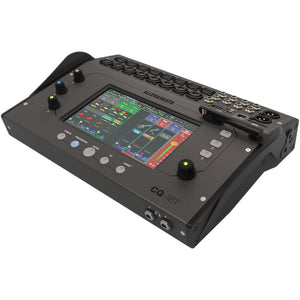
The CQ-18T is the most accessible professional digital mixer on the market for volunteer worship teams. The built-in Gain Assistant and Feedback Assistant actively help less experienced operators get a clean mix quickly, and the 7-inch touchscreen with built-in dual-band Wi-Fi means your tech can walk the room and adjust the mix from anywhere using the free CQ MixPad app without needing a separate router. 16 input channels, 96kHz processing, and 6 aux outputs give a small worship team everything needed for a full Sunday morning. This console runs at 96kHz when most at this price point run at 48kHz, which translates to more headroom and less listening fatigue over a long service.
Shop at SoundPro →
The TF1 is the gold standard answer to "what is the easiest digital mixer to learn?" The TouchFlow Operation interface puts every function within one or two touches, and the fader-based layout feels immediately familiar to anyone who has ever used an analog board. For a worship team transitioning from analog to digital, the TF1 eliminates the learning curve that causes volunteer burnout. 16 input channels, 10 aux buses for a growing IEM system, and Yamaha's D-PRE microphone preamps deliver professional audio quality in a package that a new volunteer can operate reliably within a few Sundays.
Shop at SoundPro →For mid-size and large church consoles, our complete digital mixer guide for churches covers the Allen & Heath SQ-6, Midas M32, and Avantis in detail, including comparison tables and specific recommendations by congregation size.
Step 3: In-Ear Monitor Setup for Your Worship Team
In-ear monitors are the single highest-impact upgrade most worship teams can make. When every performer has their own personal mix in their ears, stage volume drops, the front-of-house mix improves, and hearing health is protected. The transition from floor wedges to IEMs transforms Sunday morning from a volume negotiation into a controlled, consistent experience.
Each performer's IEM mix comes from a dedicated aux send on your console. The console routes that aux output to a wireless IEM transmitter, which broadcasts the mix to the performer's bodypack receiver and earphones. One aux send per performer, one transmitter per aux send, one bodypack and earphone set per performer.

The PSM 300 is the professional benchmark for worship team IEM systems. Shure's patented Audio Reference Companding delivers one of the cleanest wireless audio chains at this price point, which means the subtle dynamics in a worship mix translate clearly to every performer. MixMode lets performers blend two console inputs from the bodypack, which is ideal for keeping the click track on its own channel independent from the mix. One-touch frequency scan and sync keeps setup simple for volunteer tech teams. Available as a single or twin pack for pairing two performers on one transmitter channel.
Shop at SoundPro →SoundPro's HOW specialists design complete worship team audio systems every week. Let us build your system right the first time.
Step 4: The PA System and Main Speakers for Your Worship Team Audio Setup
Your PA system is what takes the final mix from your console and delivers it to the congregation. For most churches, this means a pair of full-range powered speakers positioned at the front of the room, supplemented by subwoofers if your worship style involves significant low-frequency content from bass guitar, kick drum, or electronic instruments.
What to look for in a church PA system
The most important factor for church PA systems isn't raw power — it's coverage. Every seat in your sanctuary needs to receive the same clear, balanced sound level. A well-placed, properly aimed pair of speakers covers a typical worship space far more effectively than a more powerful system poorly positioned. For rooms with balconies, hard parallel walls, or unusual dimensions, SoundPro's HOW specialists can design a system that accounts for your specific acoustics.

The JBL PRX912 is a workhorse for mid-size church PA systems: 132dB of maximum output, a 12-inch driver for warm, natural low-midrange, 12-band parametric EQ, and dbx DriveRack technology including Automatic Feedback Suppression built directly into the speaker. The G-Sensor Automatic Position Detect optimizes tuning based on speaker orientation, and the JBL Pro Connect app gives your tech team full control of up to 10 speakers from a phone or tablet. A pair of PRX912s handles most mid-size sanctuaries cleanly, with the option to add PRX subwoofers as your room and worship style requires.
Shop at SoundPro →Livestream audio output
If your church streams services online, your console needs one additional dedicated output: the stream mix. This is separate from your main PA mix and your monitor mixes, and it's configured specifically for home listening in earbuds and phone speakers. Direct vocals up, reduce room reverb, and apply gentle compression across the mix bus. Most digital consoles have sufficient aux buses to support this without any trade-offs. Our church live streaming equipment guide covers the full streaming setup in detail.
Complete Worship Team Audio Setups by Church Size
Here's how a complete worship team audio system scales from small to large, and where to prioritize investment at each stage.
| Church Size | Console | Wireless Mics | IEM Channels | PA |
|---|---|---|---|---|
| Under 200 seats | Allen & Heath CQ-18T or Yamaha TF1 | 2–4 wireless channels | 3–4 IEM channels | Pair of powered 12" speakers |
| 200–500 seats | Allen & Heath SQ-5 or Midas M32R | 4–8 wireless channels | 5–8 IEM channels | Pair of 15" speakers + subwoofer |
| 500–1,000 seats | Midas M32 or Allen & Heath SQ-6 | 8–12 wireless channels | Full band IEM system | Line array or larger fixed install |
| 1,000+ seats / multisite | Allen & Heath Avantis or dLive | 12+ wireless channels | Full wireless IEM system | Engineered installed sound system |
Common Worship Audio Setup Mistakes and How to Avoid Them
These are the problems SoundPro's HOW specialists see most often in church audio systems, and all of them are avoidable.
- Using the house mix for the livestream. The house mix is tuned for a reverberant room full of people. It sounds terrible in earbuds. Always create a dedicated stream mix. This is the single most impactful fix most streaming churches can make today without buying anything new.
- Not counting aux buses before buying a console. Your console needs one aux bus per performer who needs their own IEM mix, plus one for the stream mix, plus one for any floor wedge zones you're still running. Run the math before you buy. Running out of aux buses is one of the most frustrating limitations a growing worship team hits.
- Putting everyone on wedges when IEMs are available. The full benefit of IEM monitoring only kicks in when the entire stage is on in-ears. One person still on a loud wedge undermines stage volume reduction for everyone else. Phase the rollout methodically, but commit to getting the whole team over.
- Skipping acoustic treatment. No amount of good equipment overcomes a room that fights itself. Parallel hard walls, a low ceiling, and no absorption turn even the best PA system into a muddy mess. Before upgrading equipment, have an honest conversation about whether the room itself needs treatment.
- Not training volunteers on new gear. The best equipment underperforms with an untrained operator. Every new system purchase should include structured training. SoundPro's HOW specialists can support your team with training as part of the purchase process.
- Ignoring RF coordination. Running IEM systems, wireless mics, and guitar links all on uncoordinated frequencies causes dropouts and interference. Use your wireless system's built-in frequency scan tools with all systems active simultaneously and coordinate all frequencies before every install.
"The worship team audio setup conversation almost always starts with 'we need a new PA' and ends with 'we actually needed a better console and IEMs first.' The PA is the last thing in the chain — improve everything before it before you replace it."
Next Steps
If you're ready to design or upgrade your worship team audio setup, here's the path SoundPro's HOW specialists walk through with every church.
- Audit what you have. Inventory your current microphones, console, monitors, and PA. Most churches have more reusable gear than they realize. You may only need to upgrade one component rather than replace the whole system.
- Count your sources and buses. How many input channels do you need? How many performers need independent IEM mixes? Does your church stream? Each of these answers defines a minimum spec before budget enters the conversation.
- Read the deep-dive guides. Our complete digital mixer guide for churches covers every console recommendation by church size. Our complete IEM guide covers everything from RF coordination to console configuration. And our church livestreaming guide covers the streaming signal chain in full.
- Call SoundPro before you finalize anything. Our HOW Account Managers design worship team audio systems every week. A 20-minute conversation covers your room, your team, your current gear, and your budget before any recommendation is made. That conversation has saved hundreds of churches from a $3,000 to $10,000 mistake.
- Digital Mixers at SoundPro
- Wireless IEM Systems at SoundPro
- Wireless Microphone Systems at SoundPro
- PA Speakers at SoundPro
- Best Digital Mixer for Church 2026
- Complete In-Ear Monitor Guide 2026
- Church Live Streaming Equipment Guide
Get a custom quote from SoundPro's certified House of Worship specialists. We'll design the right system for your room, your team, and your budget.
FAQ: Worship Team Audio Setup
What audio equipment does a worship team need?
A complete worship team audio setup includes four core components: wireless microphones and direct boxes for your vocalists and instruments, a digital mixing console to combine and balance all audio sources, an in-ear monitor system so each performer hears their own personal mix on stage, and a PA system to deliver the final mix to the congregation. For churches that stream services online, a dedicated stream mix output from the console feeds the livestream encoder as a fifth component. SoundPro's HOW specialists can design the full system for your church size, room, and team.
What is the best digital mixer for a worship team?
For small churches with volunteer teams, the Allen & Heath CQ-18T and Yamaha TF1 are the top choices. Both are designed specifically for non-professional operators. For mid-size churches running full bands with IEM systems, the Allen & Heath SQ-6 and Midas M32 are the professional standards. For large and multisite churches, the Allen & Heath Avantis provides broadcast-grade quality with full networking capabilities. Our complete digital mixer guide covers all five consoles in depth.
Do worship teams need in-ear monitors?
IEMs aren't strictly required, but they are the most impactful upgrade most worship teams can make. When every performer has their own personal mix in their ears, stage volume drops dramatically, the front-of-house engineer gains control of the room mix, hearing health is protected, and consistency improves from week to week. The transition from floor wedges to IEMs typically improves overall sound quality in the room more than any other single change. Our complete IEM guide covers the full system setup.
How many wireless microphone channels does a worship team need?
A typical small worship team needs 2 to 4 wireless channels: one for the worship leader, one for the pastor or teaching leader, and one to two for additional vocalists. Mid-size teams with full choirs or multiple vocalists typically run 6 to 10 channels. Always coordinate your wireless mic frequencies with your IEM system frequencies before purchasing, as they share the same RF spectrum. SoundPro's HOW specialists can help you design a coordinated wireless plan for your specific setup.
How do I set up audio for a small church worship team?
For a small church worship team, start with a digital console like the Allen & Heath CQ-18T or Yamaha TF1 that's designed for volunteer operators. Add 2 to 4 channels of digital wireless microphones for your vocalists and pastor. Configure 3 to 4 wireless IEM channels for your key performers, fed from dedicated aux sends on the console. Run the main console outputs to a pair of powered PA speakers positioned at the front of the room. This four-component system handles a complete Sunday morning service and scales cleanly as your team grows.
What PA speakers are best for a church worship team?
For most mid-size churches, a pair of powered 12-inch or 15-inch full-range speakers handles the main sanctuary well. The JBL PRX912 is a strong choice for churches that want professional-grade output with built-in DSP and app control. For larger sanctuaries or churches with specific acoustic challenges, line array systems or custom installed sound designs are worth exploring. SoundPro's HOW specialists can evaluate your room dimensions and recommend the right speaker configuration for consistent coverage across every seat.
How much does a complete worship team audio setup cost?
A complete professional worship team audio system for a small church runs $8,000 to $20,000 depending on team size and room size. This includes a digital console ($1,500 to $3,500), wireless microphones ($600 to $800 per channel), wireless IEM systems ($900 to $1,500 per channel for 3 to 5 channels), and PA speakers ($1,500 to $4,000 for a pair). Mid-size church systems with full band IEM rigs and more channels typically run $20,000 to $50,000. SoundPro's HOW Account Managers can provide personalized pricing for your exact configuration.
How fast can SoundPro ship worship audio equipment?
In-stock items ship same day on orders placed before 4:00 PM CST. For complete system builds with multiple components, SoundPro's Account Managers can map out a delivery timeline and help you prioritize which components arrive first. If you're planning a system install before a fall series launch, reach out now — wireless system components and consoles can have lead times during peak season, and building in extra time protects your install window.


